
CLINICAL RESOURCE
SNPs that Affect Inflammation and Autoimmune Disease
Quick Reference Guide for Health Practitioners
This clinical resource reveals how key genomic SNPs influence inflammation, immune dysfunction, and chronic disease risk—giving you the tools to create personalised, root-cause solutions for your patients.
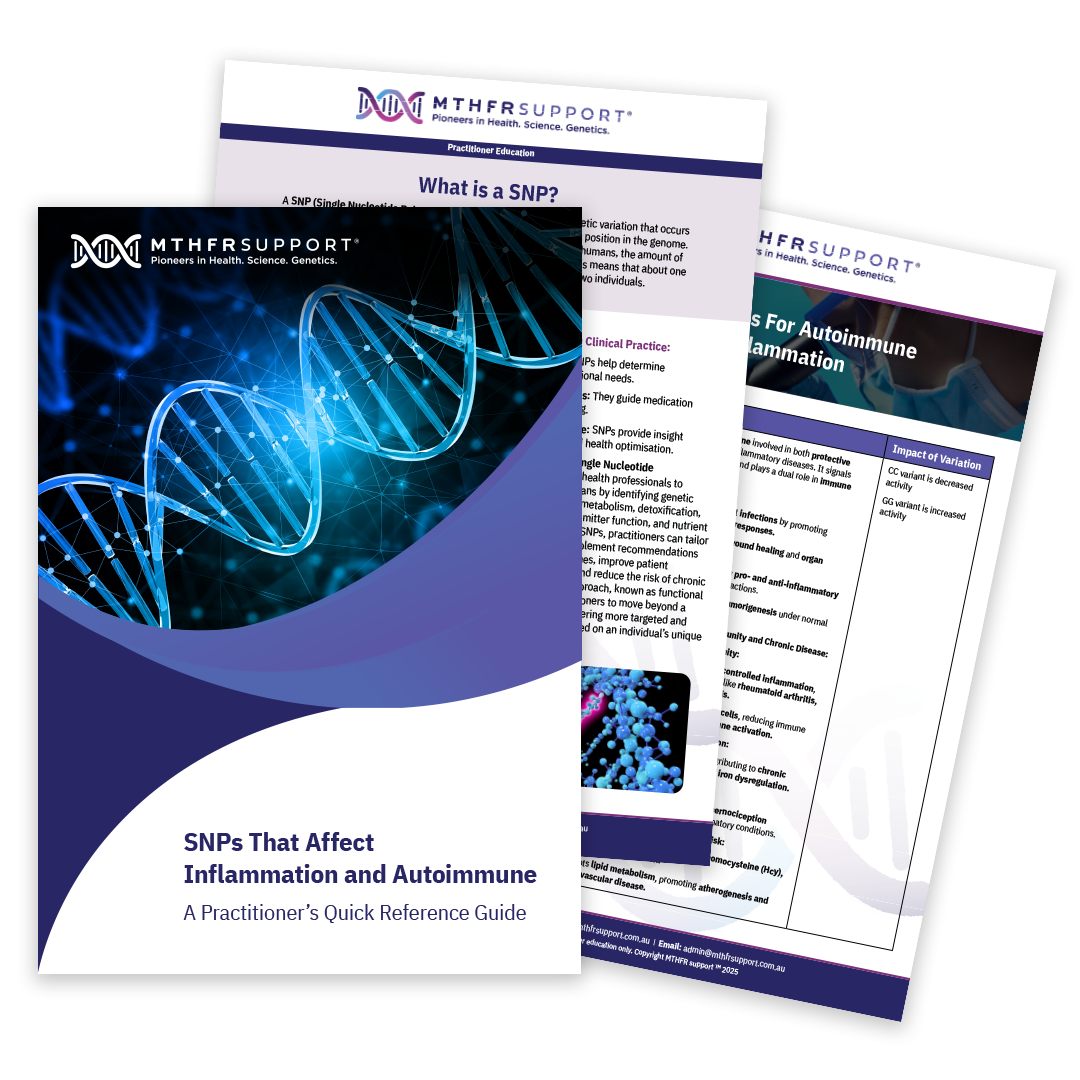
Unlock the missing piece in autoimmune care. Buy this handy reference guide and start using genomics in practice!
Do you have patients with inflammation or autoimmune issues?
They may have genetic SNPs that put them at risk contribute to disease progression.
By understanding how inflammatory gene SNPs interact with environmental, lifestyle, and pharmaceutical factors, you can customise treatment plans for each patient and significantly improve outcomes.

Learn the key inflammatory SNPs and help your patients:
- Decrease pro-inflammatory cytokines that are promoting inflammation and autoimmune conditions.
- Increase anti-inflammatory cytokines to slow down or turn-off inflammatory cascades.
- Reduce the risk of developing chronic inflammation or autoimmune disease.
- Support immune function, mucosal and tissue integrity, mitochondrial and cardiovascular health and more.
Who should get this guide?
Health care practitioners who want to deepen the support and outcomes of patients with chronic inflammatory and autoimmune diseases in the following areas...
- Gut Health Issues and IBD
- Metabolic disorders e.g. Diabetes, Cancers
- Systemic Tissue Disorders e.g. SLE, RA
- Complex multiple autoimmune diseases
- Hashimoto's
- Graves
- Vascular and Circulation dysfunction
- Thyroid Health
- and more!

What's included?
In the SNPs that Affect Inflammation and Autoimmune Disease: A practitioners Quick Reference Guide, you will:
- Identify the critical SNPs + enzymes involved in inflammation and autoimmunity.
- Understand their role in the body and why it's important to keep them working optimally.
- Learn the pathological role they play in disease progression.
- Learn the impact of each genetic SNP and the associated symptoms and conditions.
Get Our Practitioner Resource Guide: SNPs Affect Inflammation and Autoimmune Disease for ONLY $7
"The key to successfully unraveling chronic health conditions is the ability to understand a person’s genetic susceptibility and the environmental factors that contribute to biochemical dysfunction."
Carolyn Ledowsky, MTHFR Support Australia

Welcome! My Name is Carolyn Ledowsky
I’m the founder of MTHFR Support Australia and The Functional Genomics Institute.
I am a university-trained health scientist, researcher, naturopath, herbalist, and nutritionist. I have also studied genetics at Duke University (Genetics and Evolution) and the University of Maryland (Genes and the Human Condition—From Behavior to Biotechnology).
For almost two decades, I’ve dedicated my career to helping chronically ill patients from around the world—individuals who have often searched for years, even decades, to find answers for their ongoing health struggles.
I believe I've achieved success with my patients when other practitioners haven't because my practice specialises in addressing genetic susceptibility and its crucial role in chronic health conditions and overall well-being.
Because of the results I've been able to achieve with patients, my practice has grown into a multi-million-dollar empire that serves individuals around the world.
And now I want to help other practitioners do the same.
I believe that practitioners who understand genetic susceptibility will be the ones who truly thrive in practice, like I have, because they’ll see significantly better health outcomes for their patients. This knowledge leads to a thriving practice with longer waitlists and patients eager to understand how they can regain and maintain health for life.
I now have the privilege of helping other doctors, naturopaths, and health practitioners incorporate genomics into their practices so they can experience phenomenal patient outcomes and build thriving clinical practices. I'm excited to help you do the same!
If You Are New To Genomics, The First Place To Start Is To Get a Better Understanding of MTHFR and Methylation
Methylation disturbance is at the heart of many health conditions.
Variations to the genes that affect methylation, including but not limited to the MTHFR gene, can affect various bodily functions, leading to a range of health implications.
Here are 9 major health areas that can be impacted by MTHFR and methylation gene mutations:

Decrease Nutrient Absorption and Utilisation
Genetic mutations can also affect how well the body absorbs and uses certain nutrients, like folate, which is vital for many bodily processes, including, you guessed it, detoxification.

Mental Health
MTHFR mutations can impact mental health, contributing to depression, anxiety, and bipolar disorder. This is partly due to the role of the MTHFR enzyme in producing neurotransmitters like serotonin, dopamine, and norepinephrine, which are critical for mood regulation.

Increase Sensitivity to Toxins and Medications
People with MTHFR variations can find themselves more sensitive to certain toxins and medications. This is because their bodies can struggle to process and eliminate these substances effectively.

Reduce Methylation
Methylation is like your body’s internal cleaning service. It helps in detoxifying homocysteine (a harmful amino acid) and converting it into other useful substances. With a less efficient MTHFR enzyme, the detox process can be less efficient, potentially leading to an accumulation of toxins and homocysteine.

Fertility
Both men and women with MTHFR mutations may experience fertility issues. This is because the mutation can affect homocysteine levels and folate metabolism, which are important for reproductive health and embryonic development. Mutations in the MTHFR gene can lead to higher levels of homocysteine, which is associated with pregnancy complications such as preeclampsia, spontaneous abortion, and placental abruption.

Detoxification
The MTHFR gene is essential for converting homocysteine into methionine, a process that requires folate (vitamin B9). Methionine is crucial for your body's detoxification processes. A mutation in the MTHFR gene can lead to higher levels of homocysteine and reduced methionine, potentially impairing the body's ability to detoxify effectively.

Bone Health
Elevated homocysteine levels have been linked to an increased risk of osteoporosis and bone fractures. This is because homocysteine can interfere with collagen cross-linking, which is essential for bone strength.

Cardiovascular Health
Elevated homocysteine levels, which can result from MTHFR mutations, are linked to an increased risk of heart disease and stroke. The process affects the inner lining of blood vessels, potentially leading to clot formation and vascular damage.

Immune System Function
MTHFR mutations can influence the immune system's efficacy. The process of methylation, in which the MTHFR gene plays a crucial role, is vital for immune cell function and the regulation of immune responses. Disruptions in methylation can potentially lead to an increased susceptibility to infections and auto-immune conditions.
It's a complex picture, isn't it?
And there are many, many more implications of methylation disruption.
It's important to remember that having an MTHFR mutation doesn't guarantee health problems in these areas; it simply indicates a potential vulnerability. Lifestyle factors, diet, and other genetic factors also significantly determine health outcomes.